
Ph.D. by Publication
ABOUT UNIVERSITY
The Thames International University is a private higher education establishment authorized by the French Ministry of National Education, Higher Education, Research and Innovation, in accordance with and in compliance with the French Education Law: Code de l’Education Articles L 444-1 à 444-11 and R 444-1 to 444-28.
Our Mission: To be a globally recognized institution in digital higher education, empowering working professionals across the world to attain academic distinction and leadership through accessible, world-class online programs.
The Executive PhD is a specialized doctoral program for seasoned professionals, combining advanced research with practical leadership insight to drive innovation and solve real-world challenges. It empowers executives to contribute original knowledge while strengthening their strategic impact.
ABOUT PHD BY PUBLICATION
Publication doctorates are awarded to working professionals in recognition of an existng body of work, rather than at the end of a completely new research project. This route to a doctorate is also known as the PhD by portfolio or PhD by published works/published papers. It differs greatly from the conventional PhD by thesis. Rules apply to the type, the number, how recently the work has been published and how / whether they are linked. The number of publications required can vary depending on the length of the work, for example, if the pieces of research included are shorter forms of work, more items will be required to create a portolio at doctoral level and length.
A Doctor of Philosophy by Publication (also known as a Ph.D. by Published Work or Ph.D. under Special Regulation) is a manner of awarding a Ph.D. degree offered in which a series of articles are published in scholarly, peer reviewed journals, books etc. to meet the requirements for the degree, in lieu of presentation of a final dissertation.
These publications generally should not have been used in another research degree and can include Academic Papers, Book Chapters, Monographs, Books & Media Presentations.
PhD by Publication Comprehensive Handbook
This handbook combines formal academic requirements (aligned with the official Course Specification 2025)
and practical, student-friendly guidance, giving doctoral candidates a complete,
usable reference for the entire PhD by Publication journey.

Introduction
A PhD by Publication is an alternative doctoral pathway that recognises a candidate’s existing published research as evidence of doctoral-level contribution and expertise. It is particularly suited for:
- Mid-career professionals
- Researchers with existing peer-reviewed publications
- Academics who did not pursue a traditional PhD but have produced significant scholarly work
This route awards the Doctor of Philosophy (PhD) based on a portfolio of published outputs and an accompanying Critical Overview document.
Nature and Purpose of the PhD by Publication
A PhD by Publication differs from a traditional PhD in that:
-
Research is already completed before registration.
-
Publications form the core evidence of the doctoral contribution.
-
Skills, methods, and research development are demonstrated retrospectively.
-
Candidates focus primarily on producing a coherent, critical synthesis.
You must demonstrate:
-
Original and significant contribution to knowledge.
-
Mastery of research methods.
-
Ability to conceptualization, execute, evaluate, and defend research.
-
A coherent programme of scholarly activity over time.
Programme Structure
The PhD by Publication consists of two phases:

Phase One: Prima Facie Case
You must submit a Prima Facie Case for examination by a Progress Review Panel (PRP). This includes:
- A proposed list of 4–6 publications.
- Evidence that they form a coherent research programme.
- Proof that at least 50% are peer-reviewed journal articles or equivalent.
- All outputs published/completed within 5-7 years before initial enrolment.

Phase Two: Critical Overview & Final Submission
You develop a Critical Overview (up to 10,000 words) that:
- Explains the coherence of your research outputs
- Demonstrates the originality and significance of your contribution
- Shows how your research meets doctoral-level expectations
- Portfolio of publications
- Critical Overview document
- Viva Voce
The Critical Overview Document
This is the core intellectual component explaining your research trajectory.
Recommended structure:
Introduction
- Background and context
- Rationale for choosing the publication route
- Overview of the research theme
Research Programme Coherence
- Background and context
- Rationale for choosing the publication route
- Overview of the research theme
Methodological Framework
- Methods used across the publications
- Justification and consistency
- Reflection on methodological evolution
Contribution to Knowledge
- What is original?
- How your work advances theory, practice, or policy
- Influence and impact (citations, engagement, changes in practice).
Reflection
- Personal development as a researcher
- Challenges, limitations, and strengths
Conclusion
- Summary of contribution
- Future research directions
- Background and context
- Rationale for choosing the publication route
- Overview of the research theme
- Background and context
- Rationale for choosing the publication route
- Overview of the research theme
- Methods used across the publications
- Justification and consistency
- Reflection on methodological evolution
- What is original?
- How your work advances theory, practice, or policy
- Influence and impact (citations, engagement, changes in practice).
- Personal development as a researcher
- Challenges, limitations, and strengths
- Summary of contribution
- Future research directions
Educational Aims of the Programme
This programme aims to ensure candidates demonstrate:
-
Creation/interpretation of new knowledge at doctoral level
-
Systematic understanding of a field
-
Ability to conceptualise and execute advanced research
-
Mastery of research techniques
-
Capacity to defend knowledge claims with rigour

Programme Learning Outcomes
Graduates will be able to:
- Critically analyse and synthesise complex knowledge
- Conduct research independently and ethically
- Communicate research effectively to specialist and general audiences
- Lead and collaborate within academic/professional settings
- Influence policy, practice, and scholarship through research impact
Admission Criteria
To apply, candidates must:
- Meet institutional postgraduate research entry requirements
- Provide evidence of a coherent body of published work
- Demonstrate readiness to produce a Critical Overview A DBS check may be required depending on research area.
Examination: Viva Voce & Outcomes
- Original contribution to knowledge
- Coherence of the overall research programme
- Critical engagement and methodological competency
- Understanding of the field and impact
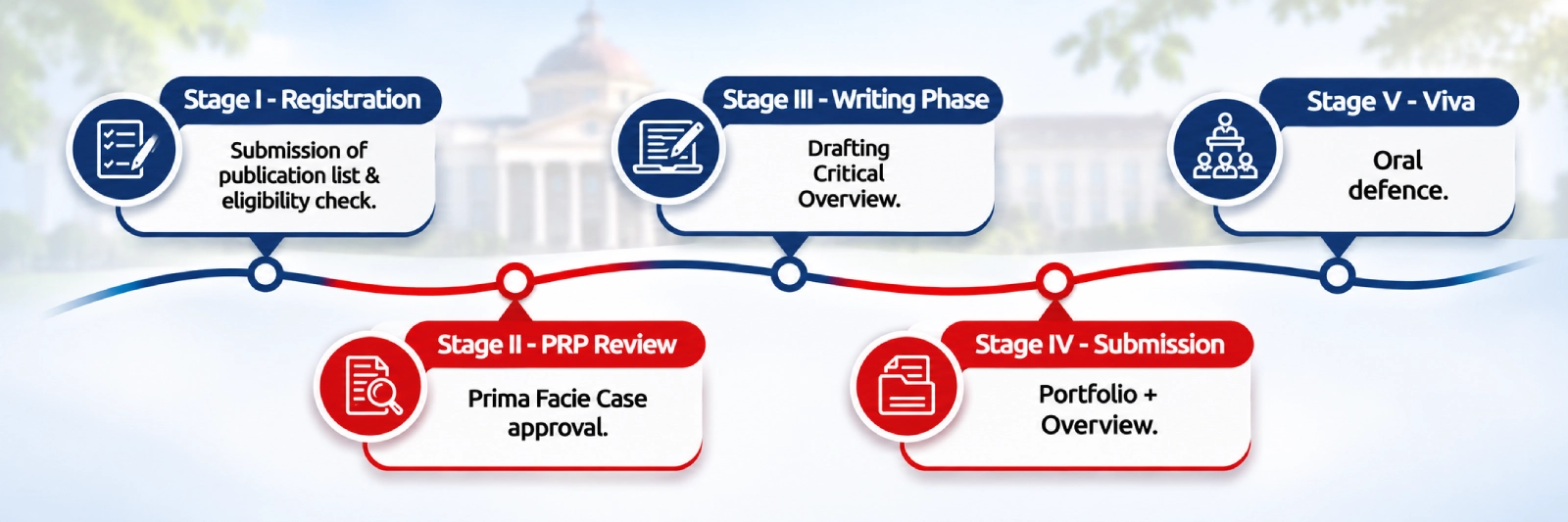
Timeline & Milestones
Frequently Asked Questions
No, only published or accepted outputs.
Yes, if peer-reviewed and relevant to the discipline.
Yes, one repeat allowed.
They cannot be used unless excepti onal approval is granted.